US Opens Protected Tanker Corridor in Strait of Hormuz, Cutting Iran’s Leverage
The US quietly launched a protected tanker corridor near Oman to keep oil flowing through Hormuz, limiting Iran’s ability to disrupt shipments.
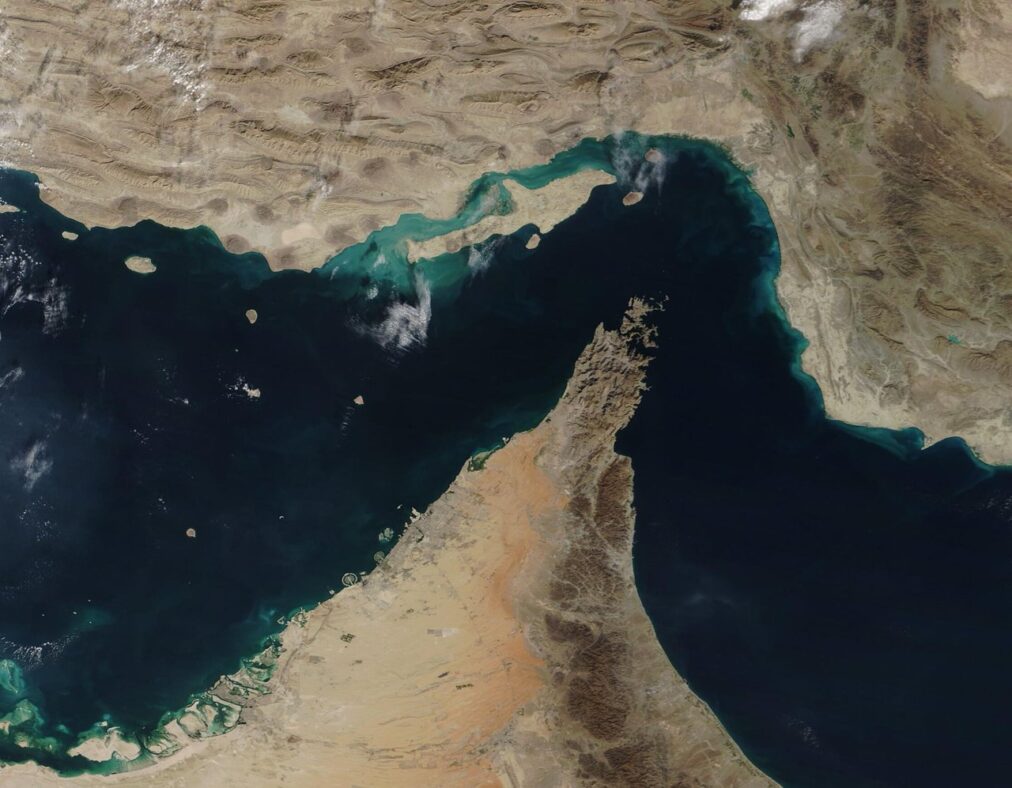
MODIS Land Rapid Response Team, NASA GSFC/Wikimedia Commons
The United States has quietly established a heavily guarded tanker corridor near the southern edge of the Strait of Hormuz, a strategic maritime chokepoint, aiming to ensure steady oil shipments despite ongoing threats from Iran. Overseen by a U.S. Army task force based at Fort Bragg, North Carolina, this new shipping route near Oman seeks to reduce Tehran’s ability to disrupt vital energy exports that flow through the region.
Strategic Importance of the Strait of Hormuz
The Strait of Hormuz is one of the world’s most important energy passages, linking the Persian Gulf to the Gulf of Oman and the Arabian Sea. It serves as a critical artery for global oil supplies, with roughly 20 million barrels of crude oil passing through daily under normal conditions. Disruptions in this narrow waterway can lead to significant economic ripple effects worldwide, including higher fuel prices, increased shipping costs, and delayed deliveries of goods.
By creating a secure southern channel near Oman for tankers to navigate, the United States aims to maintain at least half of the pre-conflict shipping volume—around 10 million barrels per day—thus preventing a near-total shutdown that could severely impact global markets.
How the New Tanker Corridor Operates
According to reports sourced from Axios and National Security Journal, the corridor has been active for several weeks, handling 15 to 20 tankers each night. Unlike traditional escort missions, this initiative functions as a managed logistical system. Empty tankers enter the Persian Gulf from the Arabian Sea, load oil from Gulf producers, and then exit through the protected southern route.
Positioning the corridor closer to Oman rather than Iran’s coast places vessels farther from Iranian missile sites and fast-attack naval forces. While the route is not immune to potential attacks by drones, missiles, or mines, the extensive U.S. military oversight significantly reduces risk and disrupts Iran’s ability to exert complete control over maritime traffic.
Implications for Iran’s Regional Leverage
Iran has long leveraged the Strait of Hormuz’s geography to exert influence over global energy markets, threatening commercial shipping with an array of tactics including missile strikes, drone attacks, and mining operations. This new corridor directly challenges Tehran’s strategic advantage by demonstrating that the United States and its allies can secure a reliable passage despite Iranian hostility.
While this U.S.-backed operation does not claim full control of the strait, it undermines Iran’s ability to hold global oil shipments hostage and weakens its bargaining power in the ongoing regional security crisis.
Challenges and Future Outlook
Maintaining the corridor demands continuous military vigilance and resource investment. The U.S. task force at Fort Bragg, along with regional partners, must remain alert to the threat of asymmetrical attacks and miscalculations that could escalate tensions. The corridor’s success also relies on diplomatic coordination to keep shipping lanes open without provoking broader conflict.
In the coming months, the effectiveness of this protected route will be a key indicator of whether the U.S. can sustain a stable flow of oil exports from the Gulf amid Iran’s ongoing efforts to disrupt maritime traffic.
The opening of this southern tanker corridor marks a significant strategic adjustment in one of the world’s most sensitive maritime regions, signaling a shift in the balance of power over the Strait of Hormuz and a reduction in Iran’s ability to use the waterway as a geopolitical weapon.