US, Iran Talks Yield ‘Encouraging Progress’ Toward Ceasefire
Mediators Qatar and Pakistan reported progress in the first round of US-Iran negotiations aimed at ending the war, with a roadmap for a deal within 60 days.
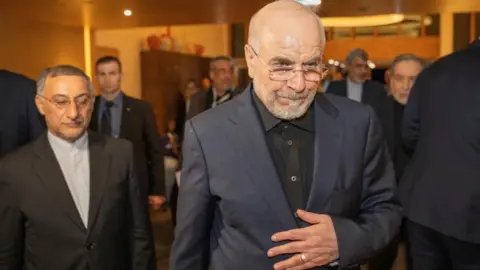
Reuters Ghalibaf arrives in Switzerland
The first round of negotiations between the United States and Iran aimed at reaching a final deal to end the war has concluded with “encouraging progress,” according to mediators Qatar and Pakistan.
In a joint statement released early Monday, the two mediating nations announced that the parties had agreed to “a roadmap towards reaching a final deal within 60 days.” Iran’s foreign minister, Seyed Abbas Araghchi, stated that “major progress” had been made toward ending the conflict in Lebanon.
A memorandum of understanding (MoU) signed the previous week includes a commitment to cease fighting on “all fronts,” including Lebanon, and to reopen the Strait of Hormuz. Araghchi shared on social media that “Pakistani and Qatari mediation has delivered major progress to end Lebanon War.” He added that “Oil and petrochem exports are waived, blockade lifted, some frozen assets released, and major reconstruction & development plan launched for Iran.”
Iranian media reported that the lead negotiators departed from the talks held in Switzerland on Monday, with technical discussions scheduled to continue. The mediators’ joint statement indicated that a “communication line” has been established “to avoid incidents and miscommunication with the aim of safe passage for commercial vessels through the Strait of Hormuz.” The statement also noted an agreement for a “de-confliction cell” involving the US, Iran, and Lebanon, facilitated by the mediating countries, to halt military operations in Lebanon.
Araghchi identified the Lebanon de-confliction cell as the first “real test.” Lebanese President Joseph Aoun spoke with senior officials from the US and Qatar on Monday regarding this issue and the broader consolidation of a ceasefire in Lebanon, according to his office. Since the MoU was signed, there has been an increase in fighting between Lebanese armed group Hezbollah and Israeli forces in southern Lebanon, along with Israeli air strikes that the health ministry reported killed dozens of Lebanese, including women and children.
A new ceasefire between Israel and Hezbollah was declared on Friday. However, continued clashes and air strikes prompted Iran on Saturday to announce the closure of the Strait of Hormuz, though tracking data suggested vessels continued to pass through it. Hezbollah affirmed its commitment to the ceasefire but stated it would resist any Israeli attempt to “seize territory or expand its occupation.” The group reported clashes with Israeli forces advancing toward the Ali al-Taher hill area, which overlooks Nabatieh in the south.
The Israeli military’s chief of staff stated on Sunday that Hezbollah had established an “underground military fortress” beneath the hill, making its destruction a “primary operational focus.” While fighting reportedly diminished on Sunday, Israeli Prime Minister Benjamin Netanyahu maintained that the Israeli military would remain in southern Lebanon as long as necessary to safeguard northern Israel. Speaking before the talks at Bürgenstock, US lead negotiator Vice-President JD Vance conveyed that Trump had urged negotiators to “turn over a new leaf.” Vance added that if Iran’s leadership would relinquish its role as a “driver of regional instability” and its “nuclear weapons ambitions for the longer term,” the US would be “willing to fundamentally transform our relationship with that country.” Iran maintains that its nuclear program is peaceful.
Under the initial deal signed last week, Iran was to reopen the Strait of Hormuz, through which 20% of the world’s oil and natural gas travels. The US also agreed to lift a military blockade on ships bound for and from Iranian ports. The deal further includes a $300 billion plan for Iran’s “reconstruction” and the US terminating “all types of sanctions” on the country. The issue of Iran’s nuclear program remains to be negotiated. On Sunday, some vessels appeared to be entering, exiting, and transiting the strait, according to location data on MarineTraffic, despite Iran’s claim of closure, which the US disputes. The initial deal also called for fighting to cease on all fronts, but in Lebanon, Israeli air strikes have since killed at least 67 people, while Hezbollah attacks have resulted in the deaths of five Israeli soldiers. Israel asserts its conflict with Hezbollah is separate from the war on Iran, which began on February 28. Lebanon became involved shortly after, when Iran-backed Hezbollah launched rockets into Israel in response to a strike that killed Iran’s supreme leader. Israel retaliated with a bombing campaign across Lebanon and occupied approximately 5% of the country’s southern territory. Since March 2, at least 4,106 people have been killed in Lebanon, according to the country’s health ministry, which does not distinguish between combatants and civilians. Israeli authorities report 36 Israeli soldiers and four civilians killed on both sides of the border.